Shopify shipped something I don't think merchants have fully clocked yet: the Universal Commerce Protocol. Buried in it is a global catalog. Millions of independent Shopify stores, every product, searchable through one protocol. No merchant auth. No API tokens. No partnership agreement. Anyone can query it.
That sounded too good to take on faith. So we tested it the only way that counts: we built something real on it and put it in the wild.
Meet DollScout
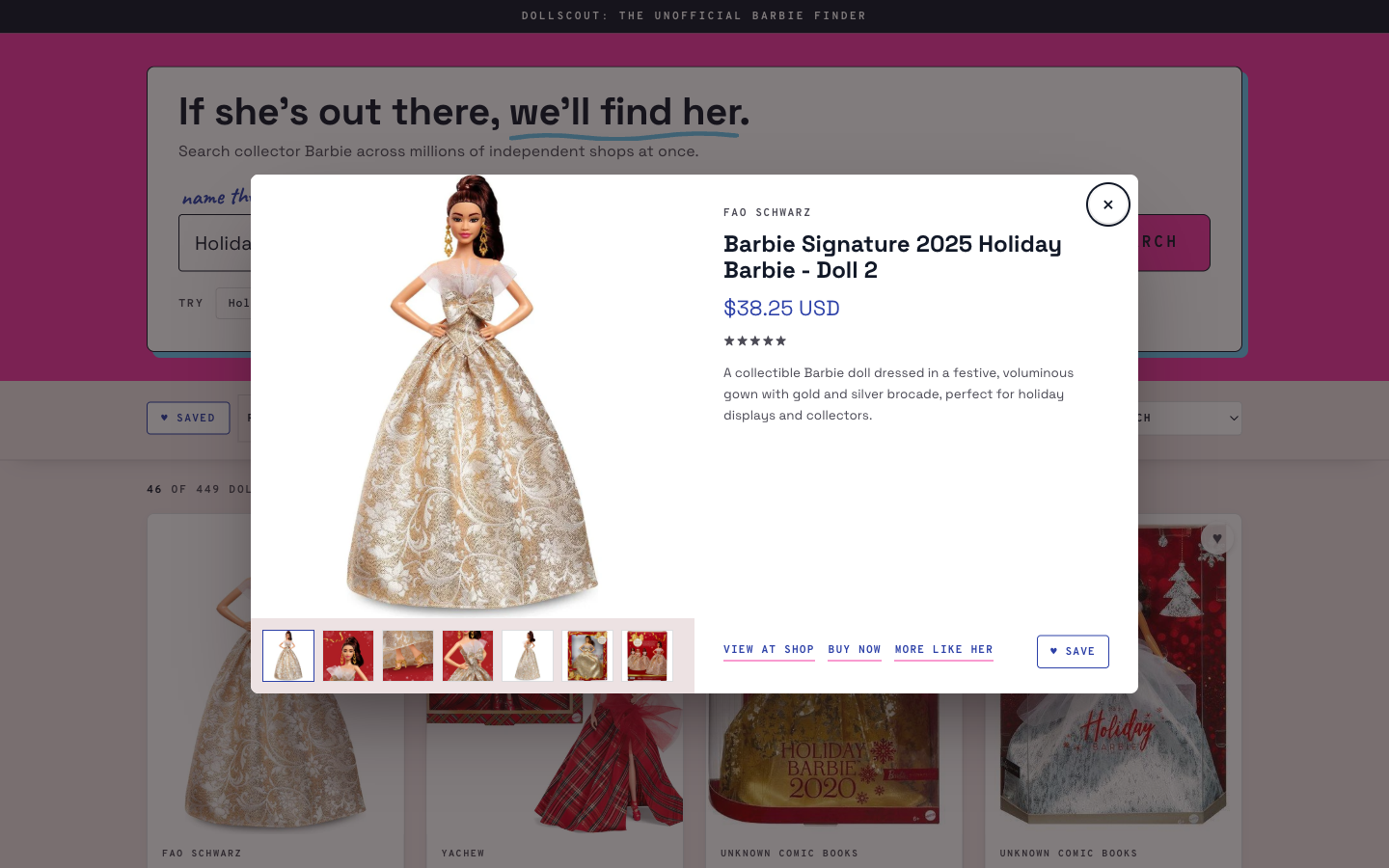
DollScout is a search engine for collector Barbie dolls. Type "1988 Happy Holidays Barbie" and you get a photo grid of live listings pulled from independent Shopify stores: price and condition filters, quick-view galleries, and a buy button that lands on the merchant's own product page.
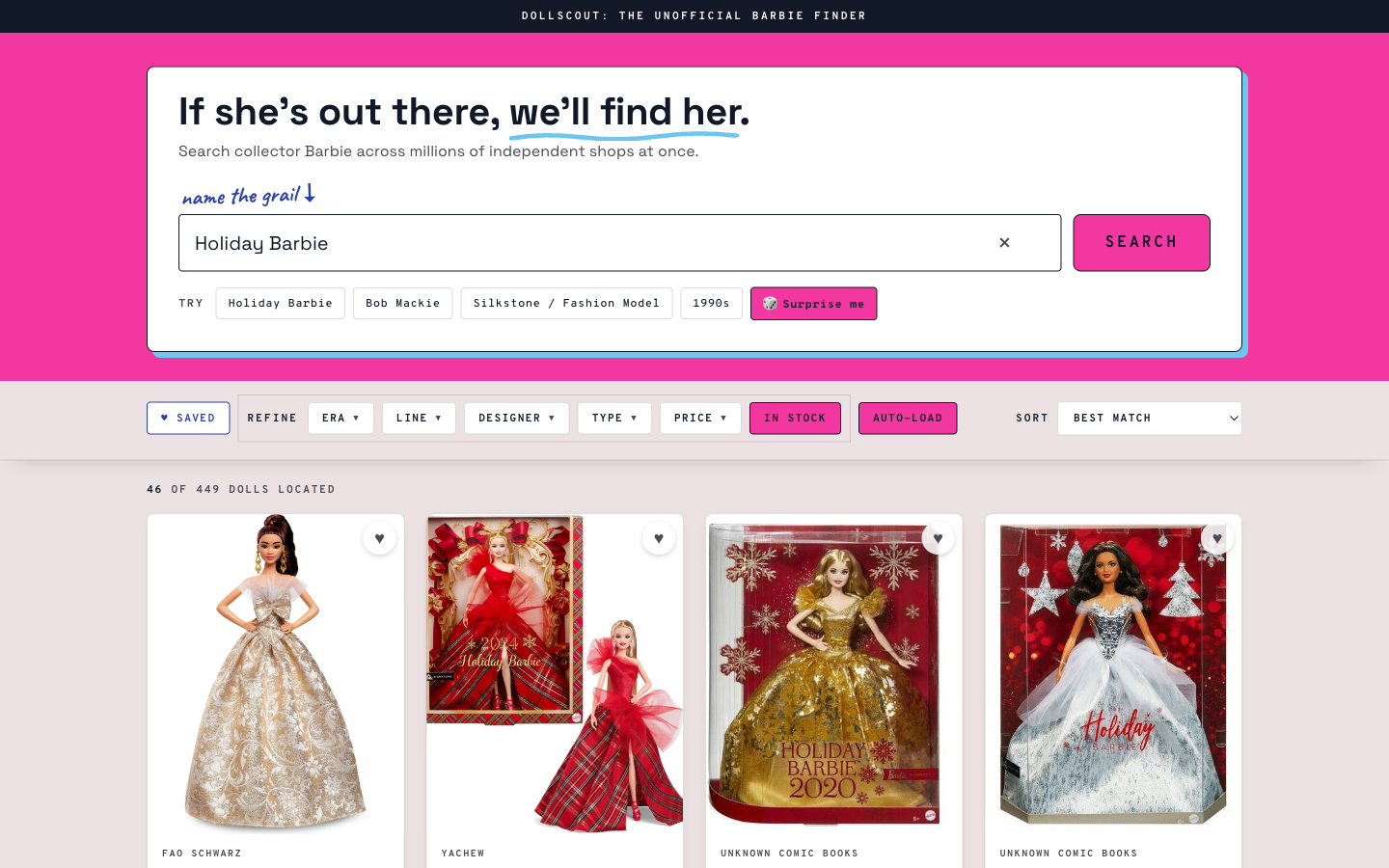
Under the hood it's almost embarrassingly small. One Python file of engine. One HTML file of UI. Zero dependencies: nothing from PyPI, no framework, no build step. The engine shells out to Shopify's ucp CLI, normalizes the JSON, and serves results. A cold search runs about 780 milliseconds. Cached repeats are effectively instant.
There's a nerdier layer too: a 3,377-doll reference catalog compiled from collector sources. When a live listing matches a canonical doll, it gets a badge: "matched: 1988 Happy Holidays Barbie Doll #1703." Search a bare stock number and DollScout knows which doll you mean.
The point isn't the dolls. The point is that this took one config file, a weekend of engine work, and permission from nobody.
The part where you get traffic for doing nothing
Here's what UCP means if you run a Shopify store.
Every result card DollScout shows is a free, high-intent referral. The shopper typed exactly what they're hunting for. The click lands on the merchant's product page: their checkout, their customer, their email capture.
The merchants in those results did nothing to be there. No integration. No feed to maintain. No app to install. No fees. Their catalog was in UCP the moment their store was on Shopify.
Compare that to every demand channel you've ever set up. Google Shopping wants a Merchant Center account and a clean feed. Amazon wants its cut and your customer relationship. Affiliate networks want a program and a pixel. UCP wants nothing from you. It's the world's largest product feed, and no merchant had to upload it.
DollScout is search-and-referral only, on purpose. It never builds a cart, never touches payment, holds no inventory. We're the mall directory, not the mall.
The rough edges
I'll be straight about what UCP is not. The global catalog has zero niche awareness. Ask it for "Ken doll" and it drifts into baby dolls. Ask for "1980s" and it cheerfully returns 80th-anniversary product. It's a pre-1.0 protocol over an all-of-ecommerce index with no taxonomy facets. The raw feed is a flea market, not a boutique.
Getting collector-grade accuracy took two layers: shape the query on the way out, filter results on the way back. A few of the actual fixes, because the specifics are the fun part:
- Anchor every query. Prepending the one word the niche always includes ("barbie") did more for relevance than everything else combined.
- Qualify ambiguous terms. Rewording the "1980s" chip to "1980s vintage" took it from 83% on-topic to 96%.
- Filter licensed merch on word boundaries. Funko Pops and Hot Wheels collabs carry the brand name but aren't the collectible. And match whole words, or your "uno" filter eats "Bruno."
- Ban sellers who never name the collab brand. A Funko specialist titling a Pop just "Holiday Barbie 1988" defeats every text filter. Filter the seller instead.
- Hold demos to a bar. Every canned search on the homepage must score at least 9 of 10 relevant in its top ten live results. We cut a genuinely funny list of weird dolls because it demoed badly. Joke quality never outranks result quality.
There's a merchant takeaway hiding in that list: finders match on your product titles and descriptions. Nothing else. Name, year, line, in plain human words. The stores that write listings the way a person describes the actual object are the ones DollScout surfaces cleanly. Keyword soup loses.
The flywheel
Now zoom out, because this is the actual thesis.
DollScout is one hobbyist finder for one weirdly specific niche, and it already routes high-intent demand to thousands of stores that don't know it exists.
UCP drops the cost of building that to a weekend. So it won't stay one finder. It'll be a finder for vinyl records, fountain pens, trading cards, diecast cars, film cameras. It'll be AI shopping agents querying the catalog mid-conversation. Price trackers. Collection managers. Editorial sites with live buy buttons. Every product a creator builds on the open catalog opens a new demand channel for every merchant already in it.
That's demand generation running in the opposite direction from every channel you're used to. You don't opt in. You don't pay to play. Creators build on the catalog because it's open, and their users become your traffic.
Steal this
We open-sourced the whole thing as awesome-ucp-demo, an MIT-licensed GitHub template. DollScout ships as the default config, so a fresh clone runs as a working demo. Point it at your own obsession by editing one config file. Even the sponsored-results disclosure mechanism is built in, in case you monetize yours (label it, it's the law).
More finders means more demand for everyone. That's the whole reason it's free. A rising tide lifts all ships.
Demo: dollscout.com. Code: github.com/kgelster/awesome-ucp-demo.
-- Kurt Elster